Price Action vs Options vs Smart Money Concepts: Which Should You Learn First?
Three popular trading approaches, one honest comparison. Learn what price action, options, and smart money concepts actually are — and which fits your goals, time, and capital.
If you are new to trading, you have probably run into three different crowds online, each insisting their approach is the way: the price-action purists, the options-income folks, and the smart-money-concepts community. It is confusing, because they are not really competing answers to the same question — they solve different problems. This is an honest comparison to help you decide where to start.
Let's define each one properly first, then talk about how to choose.
Price Action: reading the chart itself
Price action trading means making decisions from the raw movement of price — market structure, support and resistance, and candle behaviour — instead of relying on lagging indicators. The core idea is that everything (news, sentiment, order flow) eventually shows up in price, so you learn to read price directly.
It is the most foundational of the three. Whether you eventually trade options, futures, or crypto, you still have to decide where and when — and that is a price-action skill. It is also the cheapest to start: you can learn and practise with almost any account size because you are learning to read, not committing large capital.
The trade-off is that "just read the chart" is deceptively hard. Without a structured framework it turns into guessing, and beginners often bounce between setups without ever building consistency.
Smart Money Concepts: a specific lens on price action
Smart Money Concepts (SMC) is, in a sense, a specialised branch of price action. It reads the same charts but through a particular story: that price is engineered to run the resting orders (liquidity) that retail traders leave behind, and that institutions leave footprints — order blocks, fair value gaps, breaks of structure — you can learn to read.
SMC appeals to people who want a why behind every move rather than just "the level held." Done well, it is a rigorous, structured way to read a chart. Done badly, it becomes a jargon collection where every losing trade gets re-labelled after the fact. Because it builds directly on market-structure basics, most people find it easier after they can already read plain price action. The two signals at the heart of it are break of structure and change of character — our guide to BOS vs CHoCH breaks those down in plain English if you want a feel for how SMC actually reads a chart.
Options: a different tool entirely
Options are not a way of reading charts — they are a set of instruments with their own mechanics. Selling options for income (cash-secured puts, covered calls, the Wheel, credit spreads) is about collecting premium and letting time decay work for you, with risk defined before you enter. It is less about predicting direction precisely and more about probability, position sizing, and management.
Options attract people who want income and defined risk rather than chart-by-chart directional calls. The catch is a steeper conceptual ramp — the Greeks, expiration, assignment — and it is the one area where undefined-risk mistakes can genuinely hurt an account. It also typically needs more starting capital than pure chart trading (though defined-risk spreads lower that bar considerably). If capital is your main question, our breakdown of how much money you actually need to start selling options walks through the real numbers strategy by strategy.
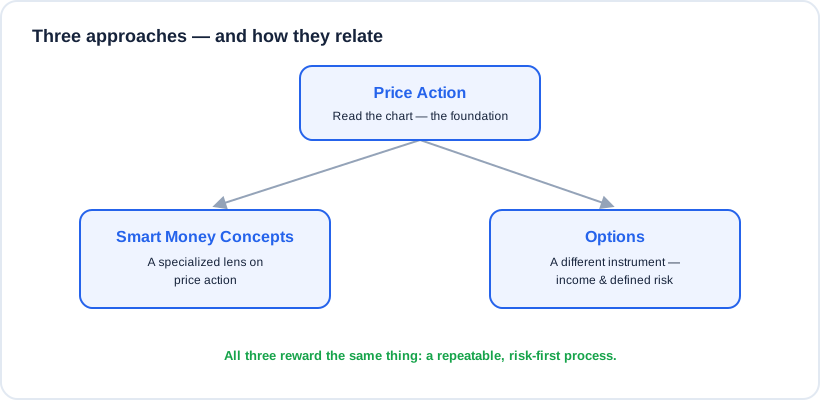
Price action is the base skill; smart money concepts is a lens on top of it; options is a separate instrument. They compound rather than compete.
Get a Free Trading Guide
Pick the path that fits how you want to trade. Each guide is a practical PDF — enter your email on the page and we'll send it straight to your inbox.
Prefer to watch first? Watch the free training
The three approaches side by side
| Price Action | Options | Smart Money Concepts | |
|---|---|---|---|
| What it is | Reading raw price — structure, support/resistance, candles | A set of instruments for income and defined risk | A specialised lens on price action: liquidity, order blocks, structure |
| Capital needed | Lowest — any account size to learn | Moderate; defined-risk spreads lower the bar | Low — same as price action |
| Time to learn | Moderate, but easy to plateau without a framework | Steeper — Greeks, expiration, assignment | Longer; builds on price-action basics first |
| Risk profile | Directional; risk is whatever your stop allows | Defined or undefined — you choose (undefined can hurt) | Directional; risk defined by structure and stop |
| Best for | Anyone needing a transferable foundation | People wanting income and probability over precise calls | Traders wanting a structured "why" behind each move |
| Main weakness | "Just read the chart" turns into guessing | Undefined-risk mistakes can genuinely hurt an account | Becomes jargon and after-the-fact excuses if done badly |
What each looks like in action
A quick picture of what a trader in each camp actually does on a given day:
- Price action: A trader watches a stock pull back to a support level that has held three times, waits for a bullish candle to close off that level, and buys with a stop just below it — a decision made entirely from the chart, no indicators.
- Options: A seller looks at a quality stock they'd happily own, sells a cash-secured put a few dollars below the current price, and collects premium — profiting if the stock stays flat, rises, or only dips slightly, with the worst case being assigned shares at a discount.
- Smart Money Concepts: An SMC trader marks the trend, waits for price to run the obvious stops below a swing low (a liquidity grab), then enters long only once price prints a change of character back up — trading the trap rather than falling for it.
How to actually choose
Rather than "which is best," ask what you want and what you have:
- You have limited capital and time, and want a foundation that transfers everywhere → start with price action. It is the base skill under all three, and the cheapest to practise.
- You already read charts and want a rigorous, structured lens on institutional behaviour → move into smart money concepts. It rewards people who have the market-structure basics down.
- You want income and defined risk more than precise directional calls, and you are willing to learn new mechanics → learn options — ideally starting with defined-risk strategies so your worst case is always a known number.
There is also a natural order for most people: price action first, to learn to read the chart, then either SMC to go deeper on that reading or options to change how you express a view. These stack on each other. A trader who reads structure well and also understands defined-risk options simply has more in the toolbox than someone who only ever learned one thing.
Key takeaways
- They solve different problems. Price action is a skill, options is an instrument, SMC is a lens — not three answers to one question.
- Price action is the foundation. It is the cheapest to practise and the base skill under the other two.
- SMC comes easier after price action. It builds directly on reading market structure.
- Options are about defined risk and income, with a steeper learning curve and the only real undefined-risk danger of the three.
- Order beats style-hopping. Pick the one that matches your goals and capital, go deep, and define risk before every trade.
The honest bottom line
None of these is a shortcut, and none is a holy grail. What actually separates traders who last from those who don't is not the style they picked — it is whether they built a repeatable, risk-first process and stuck to it. Every one of these approaches works for people who do that, and fails for people who don't.
So don't agonize over the choice. Match the approach to your goals and your starting point, commit long enough to actually get good at it, and never put on a trade without knowing your risk first. If you want a structured starting point in any of the three, VASA runs a free guide and a free live training for each — price action, options, and smart money concepts — so you can sample the actual method before committing to a path.
Get a Free Trading Guide
Pick the path that fits how you want to trade. Each guide is a practical PDF — enter your email on the page and we'll send it straight to your inbox.
Prefer to watch first? Watch the free training
Educational content only — not financial advice. Trading involves substantial risk of loss and is not suitable for everyone.