How Much Money Do You Actually Need to Start Selling Options?
A clear, honest breakdown of the capital you need to sell options for income — cash-secured puts, covered calls, and defined-risk spreads — and how to start small safely.
It is the first practical question every new options seller asks, and most answers online are either "you need $100,000" or "you can start with $50" — both unhelpful. The honest answer is: it depends entirely on which strategy you use, because different ways of selling options tie up wildly different amounts of capital. Let's go through the main ones with real numbers so you can see exactly where you fit.
Two quick notes before the math. First, in US markets one options contract controls 100 shares, so everything scales in blocks of 100. Second, this is educational — not a recommendation to trade any specific strategy or size. The point is to understand the mechanics.
Cash-secured puts: priced off the stock, not the option
A cash-secured put means you sell a put and set aside enough cash to buy the 100 shares if you are assigned. So your capital requirement is tied to the strike price of the stock, not to some small option premium.
Sell a put on a $30 stock at the $28 strike, and you need to reserve $2,800 (100 × $28) as collateral. Do the same on a $200 stock and you are reserving $20,000 for a single contract. That is why the stock you choose matters more than almost anything else when you are starting: a beginner with a $3,000–$5,000 account can comfortably sell cash-secured puts on quality stocks priced under ~$40, but cannot touch a $300 name without over-concentrating.
The upside is that this is one of the safer ways to sell premium: your worst case is owning a stock you already wanted, at a discount to where it was trading. The downside is capital efficiency — a lot of cash sits reserved.
Covered calls: you need to own the shares first
A covered call is selling a call against 100 shares you already own. So the "capital" is really the cost of those 100 shares. On that same $30 stock, that is $3,000 to own the round lot, after which you can sell calls against it for recurring income.
Covered calls and cash-secured puts are the two halves of "the Wheel" — sell puts until assigned, then sell calls on the shares until they are called away, then repeat. For a smaller account, the Wheel realistically starts around $3,000–$5,000 if you stick to quality stocks in the $20–$40 range.
Defined-risk spreads: the small-account door
Here is where small accounts get real leverage — safely. A credit spread (or an iron condor, which is two credit spreads) means you sell one option and buy a further-out option as protection. That bought option caps your maximum loss, so your capital requirement collapses to the width of the spread minus the premium you collect.
Sell a $5-wide credit spread and collect $1.50, and your maximum risk is $350 for that one position (($5.00 − $1.50) × 100). That is the entire amount at stake, defined before you enter.
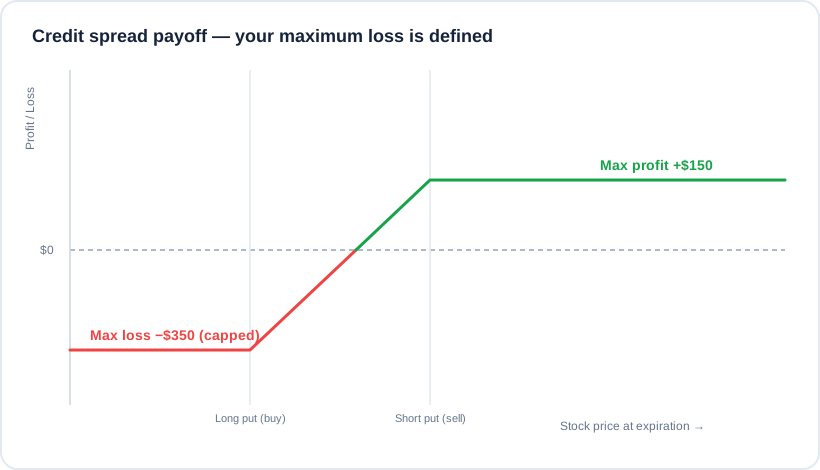
In a defined-risk spread, both your best case and your worst case are known before you enter — the loss can't run away from you. Suddenly a $2,000 account can run several small, defined-risk positions instead of one big cash-secured put.
So if capital is your constraint, spreads are usually where I'd tell someone to learn. There's nothing magic about them. You just know your worst case going in — a small, fixed number instead of the full cost of 100 shares.
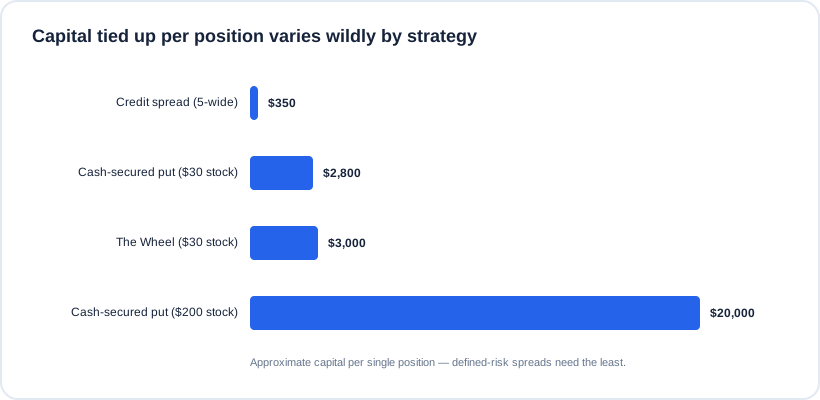
The same account can run several defined-risk spreads for the capital a single cash-secured put on an expensive stock would tie up.
Get the Options Income Starter Kit
Five defined-risk ways to sell options for income — cash-secured puts, the Wheel, credit spreads, and more. Enter your email and we'll send the free kit to your inbox.
The five strategies side by side
The same five income strategies, lined up by what they actually cost and risk. Capital figures assume a ~$30 underlying and a $5-wide spread; your real numbers scale with the stock price and width you choose.
| Strategy | Approx. capital per position | Max loss | Defined risk? | Best starting account |
|---|---|---|---|---|
| Cash-secured put | ~$2,800 (100 × $28 strike) | Strike − premium, if stock goes to zero | No (large but capped at strike) | $3,000–$5,000 |
| Covered call | ~$3,000 (own 100 shares) | Share cost − premium, if stock falls | No (large but capped at share cost) | $3,000–$5,000 |
| The Wheel | ~$3,000–$5,000 (puts → shares → calls) | Same as the leg you're in | No | $3,000–$5,000 |
| Credit spread | ~$350 (width − premium) | Width − premium, fixed | Yes | Under $2,000 |
| Iron condor | ~$700 (two spreads) | Width − total premium, fixed | Yes | $2,000–$3,000 |
The pattern is the point: the two defined-risk strategies put a small, known number at stake, while the cash-secured/covered strategies tie up far more capital for a loss that is large-but-bounded. A profit and loss calculator lets you plug in a specific strike, width, and premium to see the exact max profit, max loss, and breakeven before you ever place the trade.
So what is the realistic starting number?
Rough, honest brackets for someone starting out:
- Under $2,000 — focus on defined-risk spreads on lower-priced underlyings, small size, and treat it as tuition. Position sizing matters more than strategy here.
- $3,000–$5,000 — the Wheel (cash-secured puts → covered calls) becomes practical on quality stocks under ~$40, alongside spreads.
- $10,000+ — you gain room to diversify across a few uncorrelated positions, which is what actually smooths the equity curve.
None of these are "get rich" numbers, and that's the point. You collect premium, you manage the occasional loser, and a defined-risk edge compounds quietly over time. Almost nobody blows up an account by starting too small. They blow up by selling undefined risk in size they can't survive.
The rule that matters more than the balance
Whatever your account size, the number that keeps you in the game is not your balance — it is your risk per trade. A common guideline is to keep the maximum loss on any single position to a small fraction of the account (many use 1–5%). On a $3,000 account, that is roughly $30–$150 of defined risk per position. Size every trade to that rule first, then pick the strategy that fits.
That single discipline — defining your maximum loss before you enter, and sizing it to a fraction of your account — is the difference between a small account that grows and one that disappears on a single bad week. A position size calculator does the arithmetic for you: enter your account size, your chosen risk percentage, and a trade's max loss, and it tells you how many contracts keep you inside your rule.
What actually blows up small accounts (FAQ)
Can I start with $500? Technically yes — with tightly-sized defined-risk spreads on lower-priced underlyings, a $500 account can place a position or two. Realistically, one $350-risk spread is most of that account, so a single loser is a big dent and you have no room to diversify. Treat a sub-$1,000 account as a live practice account: real enough to teach you discipline, small enough that the tuition is affordable. The goal at this stage is a repeatable process, not income.
Are naked / undefined-risk options really that dangerous? This is the honest answer: yes, and it is where small accounts die. A naked (uncovered) short option has a loss that can be many multiples of the premium you collected — a few dollars in premium against a move that costs hundreds per contract. One gap against an oversized naked position can wipe out months of gains, or the whole account. That's the real killer — not account size. Defined-risk spreads exist precisely so your worst case is a known, small number.
How much premium can I realistically collect? Far less than the screenshots online suggest. On conservative, higher-probability defined-risk trades, premium is a modest slice of the capital at risk — think single-digit-percent returns per trade, not doubling your money. Chasing bigger premium means selling closer to the money or on more volatile names, which raises your probability of a loss in lockstep. Selling options for income is a slow grind: collect small amounts, manage the occasional loser, repeat. Anyone selling it as fast money is selling you something.
If you are still deciding whether selling options is even the right path for you versus learning to read charts directly, our honest breakdown of price action vs options vs smart money concepts compares the capital, learning curve, and risk profile of each so you can pick where to start.
If you want the five defined-risk income strategies laid out in order, each with a clear picture of the risk before you enter, the free Options Income Starter Kit walks through exactly that — cash-secured puts, covered calls, the Wheel, credit spreads, and iron condors — in plain English.
Get the Options Income Starter Kit
Five defined-risk ways to sell options for income — cash-secured puts, the Wheel, credit spreads, and more. Enter your email and we'll send the free kit to your inbox.
Prefer to watch first? Watch the free training
Educational content only — not financial advice. Trading involves substantial risk of loss and is not suitable for everyone.