Get Paid Premium, With Defined Risk
Five defined-risk ways to collect premium and let time decay work for you instead of against you — cash-secured puts, the Wheel, credit spreads, and the iron condor.
Options Income Starter Kit
5 defined-risk strategies to get paid in any market
Why Most Options Traders Lose
It's rarely the strategy. It's buying options and fighting time decay, undefined risk, and position sizing that blows up on one trade.
Fighting Time Decay
Buying calls and puts means the clock works against you every day. Sellers put that same force to work for them.
Undefined Risk
One naked position can undo months of gains. Defined-risk structures cap the worst case before you enter.
Win Often, Lose Big
A high win rate feels great — until one oversized loss erases it. Expectancy and sizing are what compound.
What's Inside the Free Guide
The five defined-risk income strategies, each with a clear picture of the risk before you enter.
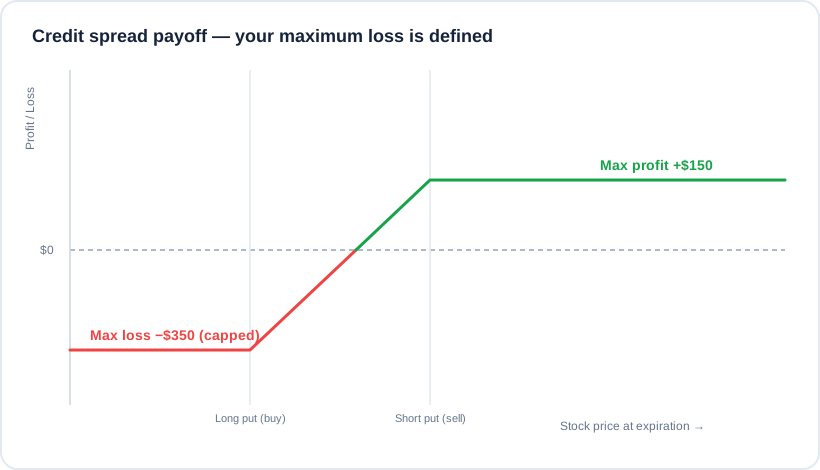
What “defined risk” looks like: a credit spread's profit is capped at the premium you collect, and — crucially — your maximum loss is capped and known before you enter.
Cash-Secured Puts
Get paid premium to buy stocks you want at a price you choose.
Covered Calls
Turn shares you own into a recurring income stream.
The Wheel
Combine puts and calls into a repeatable income engine on quality names.
Credit Spreads
Collect premium with your maximum loss defined up front.
Iron Condors
Get paid when a stock goes nowhere — range-bound, defined-risk income.
Bonus: Free Webinar
See the whole income framework applied live on real setups.
Your Path to Options Income
Learn via Email
A short series that deepens each strategy with real examples.
AutomaticThe Five Strategies, Side by Side
Every income strategy fits a different market outlook and account size. Here's the risk-and-reward shape of each — before you ever place a trade.
| Strategy | Market outlook | Max profit | Max loss | Capital needed |
|---|---|---|---|---|
| Cash-Secured Put | Neutral to bullish | Premium collected | Strike − premium (if stock goes to $0) | High — cash to buy 100 shares |
| Covered Call | Neutral to mildly bullish | Premium + gain up to the strike | Large — you own the shares as they fall | High — own 100 shares |
| The Wheel | Neutral to bullish, long-term | Recurring premium + share gains | Large — tied to holding the stock | High — cash / shares for 100 |
| Credit Spread | Directional (bullish or bearish) | Premium collected | Spread width − premium (capped) | Low to moderate — defined |
| Iron Condor | Range-bound / low volatility | Premium collected | Widest spread width − premium (capped) | Moderate — defined |
Illustrative structure only — not a recommendation. Options involve substantial risk of loss.
A Cash-Secured Put, With Real Numbers
The mechanics are simpler than they sound. Here's one full trade, start to finish.
Say a stock trades at $50 and you'd happily own 100 shares at $45. You sell one 45-strike put expiring in ~30 days and collect $1.20 per share in premium.
Either you get paid to wait, or you buy a stock you wanted at a discount to today's price — that's why it's an income-first, defined-plan trade. Model your own numbers with the options profit calculator.
Go Deeper — Free
Options Income FAQ
How much capital do I need to start?
It depends on the strategy. A cash-secured put needs enough cash to buy 100 shares at your strike (e.g. a $45 strike ties up $4,500). Defined-risk spreads need far less — often a few hundred dollars of capped risk. Start with the strategy your account can actually support.
What happens if I'm assigned?
Assignment just means you fulfil the contract. On a cash-secured put, you buy 100 shares at the strike — using the cash you already set aside — at a cost basis reduced by the premium you collected. It's a planned outcome, not an accident, which is why we only sell puts on stocks we'd want to own.
Do I need to watch the screen all day?
No. Income strategies like cash-secured puts, covered calls, and credit spreads are typically opened for weeks at a time and managed on rules, not by staring at a chart. The discipline is in the plan, not in constant monitoring.
Which markets can I trade options on?
This program focuses on US-listed stocks and ETFs with liquid, well-priced options chains, since that's where defined-risk income strategies work best. The risk principles transfer, but liquidity is what makes these trades practical.
Ready to Get Paid Premium?
Download the free Options Income Starter Kit and learn how to get paid premium without putting the whole account on one trade.
Get the Free GuideEducational content only — not financial advice. Options trading involves substantial risk of loss and is not suitable for everyone.
Keep learning
Free tools and reads to go deeper on options income.