Break of Structure vs Change of Character (BOS vs CHoCH): A Beginner's Guide
BOS and CHoCH are the two signals that tell you whether a trend is continuing or reversing. Here's how to tell them apart on a chart, with clear rules and examples.
If you have spent any time around Smart Money Concepts (SMC), you have seen the abbreviations BOS and CHoCH stamped all over people's charts. They sound technical, but the idea behind them is simple: they are the two signals that tell you whether a trend is continuing or turning. Get these two right and most of the rest of SMC starts to make sense. Get them confused and you will keep entering reversals that are really continuations, and continuations that are really reversals.
Below I'll take them apart the way I'd sketch it for a student sitting next to me — on the kind of price action you actually see on a chart, not tidy textbook diagrams.
First, what "market structure" really means
Market structure is just the sequence of highs and lows a market prints as it moves. Nothing more.
In an uptrend, price makes higher highs and higher lows — each push up runs a little further than the last, and each pullback stops a little higher than the last. In a downtrend, it is the mirror image: lower highs and lower lows. A range is when neither is happening cleanly and price bounces between roughly the same two levels.
Everything BOS and CHoCH describe is a change in that sequence. So before you can read either signal, you need to be able to mark the swing highs and swing lows that define the current trend. That is the real skill; the labels come after.
What is a Break of Structure (BOS)?
A Break of Structure is a continuation signal. It happens when price breaks past the most recent swing point in the direction the trend is already going.
In an uptrend, the market is making higher highs. When price closes above the previous swing high, that is a bullish BOS — the trend just confirmed it wants to keep going up. In a downtrend, when price closes below the previous swing low, that is a bearish BOS: the downtrend is intact and extending.
The key word is continuation. A BOS does not tell you anything new about direction — it confirms what the trend was already doing. Traders use it as evidence to stay with the move, or to add on pullbacks, rather than to fade it.
A practical rule that keeps beginners out of trouble: wait for a candle close beyond the level, not just a wick poking through. A wick through a swing high that closes back below is often a liquidity grab, not a real break — which brings us to the other signal.
What is a Change of Character (CHoCH)?
A Change of Character is a reversal warning. It is the first sign that the trend that was in control may be losing it.
Picture that same uptrend making higher highs and higher lows. Then, for the first time, price fails to make a new higher low and instead breaks below the most recent higher low. That break against the trend is a CHoCH. The "character" of the market — up until now, buyers defending every dip — has changed. Sellers just did something they had not been able to do before.
The mirror applies in a downtrend: the first time price breaks above the most recent lower high, that is a bullish CHoCH, hinting the sellers are losing grip.
CHoCH is not a guarantee of a full reversal. It is the first crack. Often what follows a CHoCH is a shift from trend into range, and only later a new trend in the other direction. Treating every CHoCH as "reverse everything now" is one of the most common ways beginners lose money with SMC.
The one difference that matters
Here is the whole thing in a sentence: a BOS breaks structure in the direction of the trend (continuation); a CHoCH breaks structure against the direction of the trend (possible reversal).
Same mechanic — price closing beyond a prior swing point — but the direction relative to the existing trend is what flips the meaning. That is why marking the trend correctly first is non-negotiable. If you mislabel the trend, you will mislabel every BOS and CHoCH that follows.
Get the Smart Money Starter Kit
The five Smart Money Concepts — market structure, liquidity, order blocks, inducement, and premium/discount — in plain English, on real charts. Enter your email and we'll send it to your inbox.
Side by side, this is the whole distinction:
| Break of Structure (BOS) | Change of Character (CHoCH) | |
|---|---|---|
| What it signals | Continuation — the trend is confirming itself | Reversal warning — the trend's first sign of weakness |
| Direction vs the trend | Breaks a swing point with the trend | Breaks a swing point against the trend |
| Example (uptrend) | Close above the previous higher high | Close below the most recent higher low |
| Example (downtrend) | Close below the previous lower low | Close above the most recent lower high |
| What to do with it | Stay with the move; look to add on pullbacks, not fade | Stop treating dips as automatic buys; wait for confirmation before flipping bias |
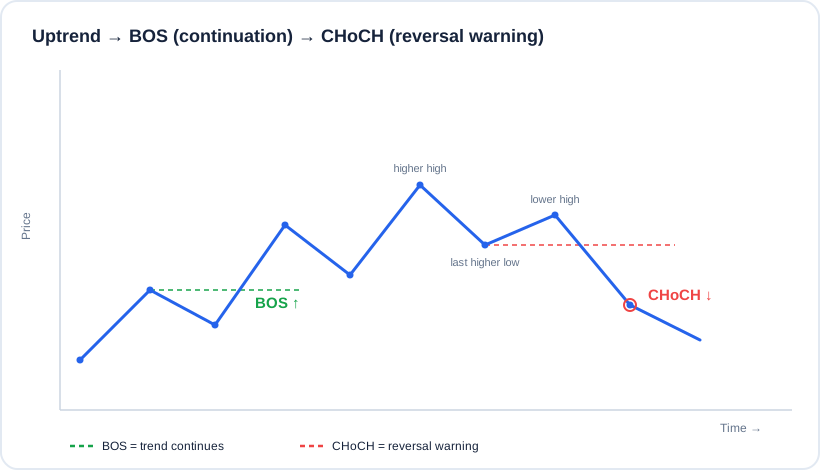
A BOS breaks structure in the direction of the trend (continuation); a CHoCH breaks against it (reversal warning). Same mechanic, opposite meaning.
A simple worked example
Say a stock — pick anything liquid, a Nifty 50 name or a large-cap US ticker — has been climbing all week: higher highs at 100, 104, 108, with higher lows at 98, 101, 105.
- Price pushes from 105 up through 108 and closes at 109. That close above the prior high of 108 is a bullish BOS. Trend confirmed up.
- Later, price rolls over from a high near 112, falls, and this time closes at 104 — below the most recent higher low of 105. That is a bearish CHoCH. It does not mean short immediately; it means the uptrend just showed its first real weakness, and you should stop treating every dip as a buy.
Notice how both were "price closed beyond a swing level." The trend context is what made one a continuation and the other a warning.
How this fits into a full SMC read
BOS and CHoCH are the skeleton. On their own they will not give you a high-quality entry — for that you layer in the other concepts: liquidity (where the stops are that price wants to run), order blocks and fair value gaps (where institutions are likely to re-enter), inducement (the obvious trap that pulls you in early), and premium/discount (whether you are buying cheap or expensive within the range).
The workflow most structured SMC traders follow is: read structure first (BOS/CHoCH to know if you are with or against the trend), then wait for price to reach a high-quality zone in the right part of the range, then take an entry with risk defined before you click. Structure tells you the story; the other tools tell you where to act on it. Once you know where your stop sits — usually beyond the swing that would invalidate the read — a position size calculator turns that stop distance into an exact share or contract count for your account, so a wrong read costs a planned amount rather than a random one.
If SMC is one of several styles you are weighing up, our comparison of price action vs options vs smart money concepts covers where each one fits and why most people learn to read plain structure before layering SMC on top.
Common mistakes with BOS and CHoCH
The mistakes I see are never exotic. It's the same four traps, over and over.
- Mislabeling the trend. Everything here is relative to the trend, so if you mark the trend wrong, every BOS becomes a CHoCH and vice versa. Fix the swing highs and lows first; the labels are downstream of that.
- Treating a wick as a break. A wick that pokes past a swing level and closes back inside is often a liquidity grab, not a break. Wait for a candle close beyond the level before you call it a BOS or CHoCH.
- Treating every CHoCH as a full reversal. A CHoCH is the first crack, not a green light to reverse your whole position. Frequently it just marks a shift from trend into range. Flipping bias on every CHoCH is a fast way to get chopped up.
- Ignoring higher-timeframe structure. A bullish CHoCH on the 5-minute chart can be nothing more than a pullback inside a clean daily downtrend. Read the higher timeframe first so you know whether a lower-timeframe signal is with or against the bigger picture.
Key takeaways
- BOS = continuation, CHoCH = reversal warning. Same mechanic (a close beyond a prior swing), opposite meaning depending on direction relative to the trend.
- Mark the trend first. Every label depends on it; get the swings right before you name anything.
- Wait for the close. A wick through a level is not a break — a candle close beyond it is.
- A CHoCH is a crack, not a reversal. Often it means "trend into range," not "flip your bias now."
- Zoom out. Check higher-timeframe structure so a small signal isn't fighting the bigger trend.
- Define risk before you act. Structure gives the story; a defined stop and a position size calculator turn it into a survivable trade.
Structure is only one piece of a full trading plan. If you are still deciding whether to focus on chart reading at all or on a different approach entirely — like collecting option premium — our guide on how much money you actually need to start selling options lays out that path with real numbers.
Want the whole framework? All five concepts, worked on real charts marked the right way, in the same plain-English style as this article — that's what the free Smart Money Starter Kit covers.
Get the Smart Money Starter Kit
The five Smart Money Concepts — market structure, liquidity, order blocks, inducement, and premium/discount — in plain English, on real charts. Enter your email and we'll send it to your inbox.
Prefer to watch first? Watch the free training
Educational content only — not financial advice. Trading involves substantial risk of loss and is not suitable for everyone.