Price Action vs Indicators: Which Actually Works for Beginners?
Should you trade with price action or indicators? Here's an honest comparison of the two approaches — what each does well, where indicators lag, and which to learn first.
New traders almost always start by loading indicators onto a chart — a moving average here, an RSI there, maybe a MACD for good measure. It feels like adding tools. Then they meet a price-action trader with a bare chart who seems to see more with less, and the obvious question follows: which approach actually works?
Here's an honest answer, without the tribalism. Both can work. But they're not equals for a beginner, and the reason comes down to one fact about how indicators are built.
The one thing to understand about indicators
Every classic indicator — moving averages, RSI, MACD, stochastics — is calculated from price. It takes past prices and runs a formula over them. That has an unavoidable consequence: an indicator can only ever react after price has already moved. It's a summary of what price did, not a read of what it's doing now.
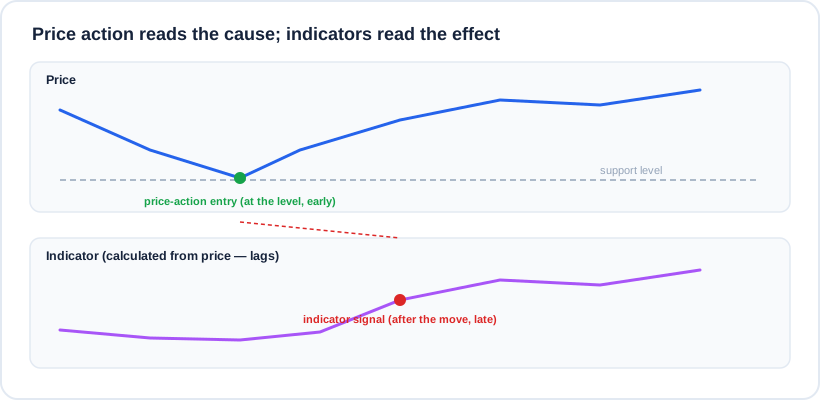
Price action reads the level directly and can act early. The indicator, calculated from that same price, flashes its signal later — after the move is underway.
This is why price-action traders talk about reading the cause while indicators show the effect. Price at a level is the event; the indicator is a delayed echo of it. Neither is magic — but only one of them is early.
What each approach is good at
Price action is reading the chart directly — market structure, support and resistance, and candle behaviour. Its strength is that it's early and universal: it works on any market and any timeframe, and you're reacting to what price is doing right now, at the level, rather than to a lagging calculation. Its weakness is that "just read the chart" is deceptively hard without a framework — beginners can turn it into guessing.
Indicators are good at one honest thing: summarising and standardising. They can make a trend or momentum easier to see at a glance, and they impose a rule ("cross above the line") that removes some discretion — which some people find steadying. Their weakness is the lag, plus a subtler trap: because an RSI or MACD looks like objective information, beginners over-trust it and end up trading the indicator instead of the market.
Side by side
| Price action | Indicators | |
|---|---|---|
| What it reads | Price itself — structure, levels, candles | A formula calculated from past price |
| Timing | Early — you act at the level | Lagging — signals arrive after the move |
| Works across markets | Yes, any market and timeframe | Yes, but settings often need tuning |
| Main strength | Reacts to the cause, in real time | Makes trend/momentum easy to see; adds rules |
| Main weakness | Hard without a framework — can become guessing | Lag; and it's easy to over-trust a number |
| Best for | Building a transferable, early read of price | Confirming or filtering, once you can read price |
So which should a beginner learn first?
Price action — and not because indicators are useless, but because of the order that actually builds skill.
Get the Top 5 Price Action Secrets
Read charts without indicators — market structure, support/resistance, and confirmation-based entries, on real charts. Enter your email and we'll send the free PDF to your inbox.
If you learn to read price first, you understand why an indicator is doing what it does — an RSI turning up is just a delayed reflection of price making a higher low you could already see. Learn indicators first, and you risk building your whole approach on lagging signals you don't understand, with no read on the price underneath them. One order teaches you the market; the other teaches you a formula.
That's the honest case, and it's the approach we take: read price first, and treat indicators — if you use them at all — as a filter or confirmation on top of a decision you already made from the chart, never as the decision itself.
Do indicators have a place at all?
Yes. Plenty of consistent traders use an indicator or two — often a moving average to gauge trend, or a momentum tool to filter. The difference is that they read price first and use the indicator to confirm, not to lead. Used that way, an indicator is a second opinion. Used the other way — as the primary signal — it hands your timing over to a calculation that's always a step behind.
The failure mode isn't "using indicators." It's the cluttered chart with six of them, all lagging, all contradicting each other, while the price action they're derived from sits ignored underneath.
Key takeaways
- Indicators are calculated from price, so they lag — they react after the move.
- Price action reads the cause in real time; indicators show a delayed effect.
- Learn price action first — it teaches you the market, and it makes indicators make sense.
- Indicators are best as confirmation or a filter, not as your primary signal.
- A cluttered, indicator-led chart is the real trap — not indicators themselves.
None of this is a holy war. It's about sequence and role: read price first, keep the chart clean, and if an indicator earns a spot, let it confirm rather than command. Traders who do that tend to see more with less.
If you want a structured way to build that read-price-first skill, VASA's free Top 5 Price Action Secrets guide starts with reading the chart itself — no indicators required. And if you're weighing which style to commit to overall, our price action vs options vs smart money concepts comparison lays out the bigger picture.
Frequently asked questions
Is price action better than indicators? For learning, yes — price action reads the market directly and in real time, while indicators lag because they're calculated from past price. But they're not mutually exclusive: many traders read price first and use an indicator to confirm.
Why do indicators lag? Because every classic indicator runs a formula over past prices. It can only produce a signal after those prices have already printed, so it necessarily reacts a step behind the price it's built from.
Should beginners use indicators at all? It's better to learn to read price first, then add an indicator only as a filter or confirmation if it genuinely helps. Starting with indicators risks building your approach on lagging signals you don't fully understand.
Which indicators are least laggy? All indicators derived from price lag to some degree — some (like shorter moving averages) react faster but also give more false signals. The lag is a feature of how they're built, which is why price action is the more direct read.
Get the Top 5 Price Action Secrets
Read charts without indicators — market structure, support/resistance, and confirmation-based entries, on real charts. Enter your email and we'll send the free PDF to your inbox.
Prefer to watch first? Watch the free training
Educational content only — not financial advice. Trading involves substantial risk of loss and is not suitable for everyone.