Smart Money Concepts vs ICT: What's the Difference and Which to Learn?
SMC and ICT overlap heavily but aren't the same. Here's an honest breakdown of the difference between Smart Money Concepts and ICT — and which one a beginner should learn first.
If you've gone down the smart-money rabbit hole, you've hit both acronyms: SMC (Smart Money Concepts) and ICT (the Inner Circle Trader methodology). People use them almost interchangeably, then argue about whether they're the same thing. The honest answer is: they're deeply related, they're not identical, and for a beginner the distinction matters less than most online debates suggest.
Here's the clear version, so you can stop wondering which one you're actually learning.
Where they come from
ICT refers to the body of trading concepts popularised by a trader known as the Inner Circle Trader. It's a large, detailed methodology built around the idea that price is driven by institutional activity — hunting liquidity, filling orders at specific levels, and moving in patterns retail traders can learn to read.
Smart Money Concepts is, in practice, the streamlined and rebranded version of those ideas that spread across the trading community. Most of what gets taught as "SMC" traces directly back to ICT concepts — order blocks, fair value gaps, liquidity, market structure — repackaged into a simpler, more shareable framework. SMC is the popular subset; ICT is the fuller, denser original.
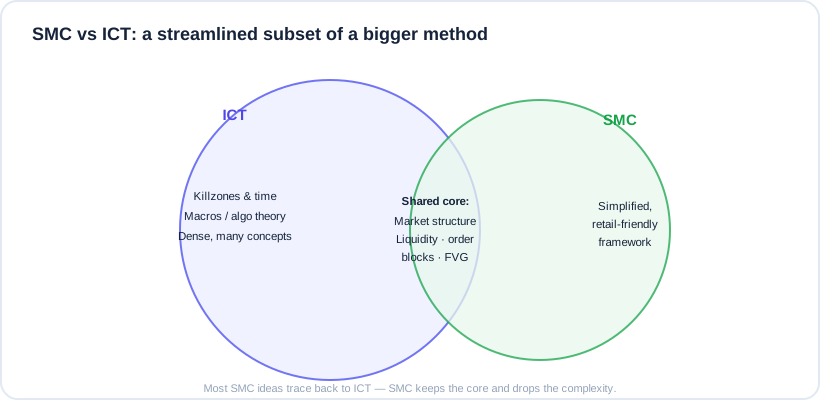
SMC keeps the shared core — structure, liquidity, order blocks, fair value gaps — and drops much of ICT's added complexity.
What they share
This is the part that matters, because it's most of the picture. Both read charts through the same core lens:
- Market structure — reading the trend from highs and lows (our market structure guide covers this foundation).
- Liquidity — resting orders above highs and below lows that price is drawn to.
- Order blocks — areas tied to strong, structure-breaking moves.
- Fair value gaps — imbalances price often returns to fill.
- Break of structure and change of character — the signals that a trend continues or turns (see BOS vs CHoCH).
If you learn these, you've learned the heart of both. The overlap is genuinely large.
Where they differ
The difference is mostly scope and complexity, not fundamentals.
| Smart Money Concepts (SMC) | ICT | |
|---|---|---|
| What it is | A streamlined, community framework | The fuller original methodology |
| Scope | The core concepts, simplified | Core concepts plus more layers |
| Extra layers | Fewer — focuses on structure & zones | Killzones/time-of-day, macros, deeper algorithmic theory |
| Feel | Cleaner, more beginner-friendly | Denser, more detailed, steeper to learn |
| Origin | Largely derived from ICT | The source most SMC ideas trace back to |
ICT tends to go further — adding time-based concepts (specific windows when moves are more likely), more granular models, and a deeper theory of how the underlying algorithm is supposed to behave. SMC usually keeps the structural core and leaves most of that extra machinery out. Neither is automatically "better"; they're different amounts of the same thing.
Get the Smart Money Starter Kit
The five Smart Money Concepts — market structure, liquidity, order blocks, inducement, and premium/discount — in plain English, on real charts. Enter your email and we'll send it to your inbox.
An honest caveat about both
We teach the useful, structural parts of this approach — and we'll be straight about the rest. Both SMC and ICT can tip into over-complication and after-the-fact rationalising, where every losing trade gets re-labelled with a new term until the chart is unreadable. The value is in the disciplined core — structure, liquidity, defined risk. The jargon arms race is not. Judge any teacher, ours included, by whether they make the chart clearer or just busier.
Which should a beginner learn first?
Start with the shared core — which is exactly what a clean Smart Money Concepts approach gives you. It's the same essential ideas as ICT with less overhead, so you build a working read of structure, liquidity and zones without drowning in time-cycle theory on day one.
If, later, you want to go deeper into the time-based and algorithmic layers, exploring ICT directly makes sense. But you'll understand it far better having learned the structural core first — and honestly, many traders find the core is enough. More concepts is not the same as more edge.
One more thing worth saying: none of this works without the basics underneath it. Both SMC and ICT sit on plain market structure, and both demand defined risk on every trade. If those foundations aren't solid, no amount of order-block terminology will save the account.
Key takeaways
- SMC is largely the streamlined, popular version of ICT — same DNA, less complexity.
- They share the core: structure, liquidity, order blocks, fair value gaps, BOS/CHoCH.
- They differ in scope — ICT adds time-based and deeper algorithmic layers; SMC keeps the structural core.
- Beginners should start with the shared core (a clean SMC approach), then go deeper into ICT only if they want to.
- Watch out for over-complication in both — value is in the disciplined core, not the jargon.
The debate over "SMC vs ICT" is mostly noise once you see that one is a slimmed-down version of the other. Learn the core well, keep your risk defined, and don't mistake a longer glossary for a better edge.
VASA's free Smart Money Starter Kit teaches that core — structure, liquidity, order blocks, inducement, and premium/discount — in plain English on real charts, without the jargon overload. It's the honest, structured place to start.
Frequently asked questions
Is SMC the same as ICT? Not exactly. Smart Money Concepts is largely a streamlined, community-popularised version of ICT. They share most core concepts, but ICT is the fuller original methodology with additional time-based and algorithmic layers that SMC usually leaves out.
Which is better for beginners, SMC or ICT? SMC is generally friendlier to start with because it keeps the essential concepts and drops much of ICT's complexity. You can always explore ICT's deeper layers later, and you'll understand them better having learned the structural core first.
Do SMC and ICT use the same terms? Largely yes — order blocks, fair value gaps, liquidity, break of structure and change of character appear in both. ICT adds more of its own concepts (like killzones and macros) on top of that shared vocabulary.
Can I trade profitably with just SMC? SMC gives you a complete structural framework, but no method guarantees profit — trading carries real risk of loss. What matters is applying the core with discipline and defined risk on every trade, whichever label you use.
Get the Smart Money Starter Kit
The five Smart Money Concepts — market structure, liquidity, order blocks, inducement, and premium/discount — in plain English, on real charts. Enter your email and we'll send it to your inbox.
Prefer to watch first? Watch the free training
Educational content only — not financial advice. Trading involves substantial risk of loss and is not suitable for everyone.