Premium and Discount Trading Explained: How Smart Money Buys Low and Sells High
Premium and discount zones show where price is expensive and where it's cheap inside a range. Here's how to mark equilibrium and use it to time entries with smart money concepts.
"Buy low, sell high" is the oldest advice in markets and the least useful, because nobody tells you what counts as low. Premium and discount is smart money concepts' honest attempt to answer that — a simple way to split any move into an expensive half and a cheap half, so "low" and "high" stop being feelings and become locations on the chart.
It's one of the easier SMC ideas to learn and one of the most practical, because it improves the price you pay on trades you were going to take anyway. Here's how it works.
What premium and discount actually mean
Take any clear price move — a swing from a low to a high. Draw a line across the exact middle of it. That midline is called equilibrium (the 50% mark). It splits the range into two halves:
- The premium zone is the upper half — above equilibrium. Here, price is expensive relative to the range.
- The discount zone is the lower half — below equilibrium. Here, price is cheap relative to the range.
That's the whole idea. Premium means expensive, discount means cheap, and equilibrium is the fair-value line between them.
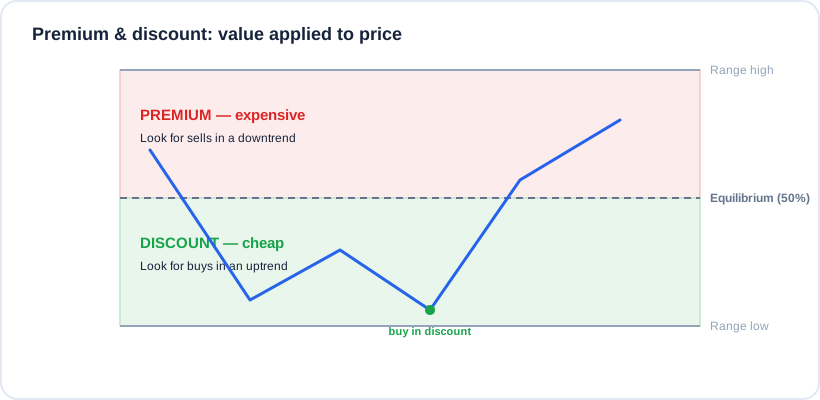
Split any swing at its 50% equilibrium. The upper half is premium (expensive); the lower half is discount (cheap). Smart money looks to buy in discount and sell in premium.
The rule that makes it useful
The point of marking premium and discount is to stop buying expensive and selling cheap — which, without a reference, is exactly what most people do when they chase moves. The rule pairs the zone with the trend:
| Market context | Where you want to act | Why |
|---|---|---|
| Uptrend | Look for buys in discount (lower half) | You're joining the trend at a cheap price, with a tighter stop |
| Downtrend | Look for sells in premium (upper half) | You're joining the downtrend at an expensive price, with less risk |
| At equilibrium | Be patient | Price is at fair value — no edge on price alone; wait for it to reach a zone |
Notice what this quietly does to your risk. Buying a pullback into discount means your stop (below the range low) is closer and your target (the range high or beyond) is further. Same trade idea, better risk-to-reward — purely because you waited for a better price.
How to mark it on a chart, step by step
- Find a clean swing. Pick an obvious move from a swing low to a swing high (or high to low). This only works with a range you can define.
- Split it at 50%. Drop a Fibonacci retracement from the low to the high (equilibrium is the 50% line), or just mark the midpoint by eye. Above it is premium; below it is discount.
- Wait for price to reach the right zone. In an uptrend, you want price to pull back into discount before you look for a long. You're not buying the top of the range.
- Then look for your actual entry signal there. Premium/discount tells you where the price is fair to act; it doesn't tell you when. You still need a trigger — a structure shift, an order block, a rejection candle.
That last point is the one beginners miss. Premium and discount is a filter on price, not a standalone entry.
Why it works
Two reasons, one honest caveat.
Get the Smart Money Starter Kit
The five Smart Money Concepts — market structure, liquidity, order blocks, inducement, and premium/discount — in plain English, on real charts. Enter your email and we'll send it to your inbox.
First, it's just disciplined value. If a market is trending up, the highest-probability, best-priced place to join is on a dip — and "discount" is a rule for defining that dip instead of guessing. Second, larger participants genuinely prefer to fill orders at better prices; the framework is retail traders' attempt to trade alongside that behaviour rather than against it.
The caveat, because we don't sell certainty: premium and discount improves your entry price and your risk-to-reward — it does not tell you the trade will win. A trend can end while price sits in discount. That's why it's always paired with structure and a defined stop, never used alone.
Combine it with structure — always
Premium and discount is a price filter. It only becomes powerful when you lay it over market structure. The sequence most SMC traders follow:
- Read the structure to know the trend — higher highs and higher lows for an uptrend.
- Wait for a pullback into discount on the relevant swing.
- Look for a shift — a change of character on a lower timeframe, or a clean rejection — as your trigger. Our BOS vs CHoCH guide covers those signals.
- Enter with your stop below the range low, targeting the opposite end of the range or the next structural level.
Structure gives you the direction, discount gives you the price, the trigger gives you the timing. Miss any one and the edge shrinks.
Common mistakes
- Using it without a trend. In a directionless chop, "discount" and "premium" flip constantly and mean little. It works best with clear structure behind it.
- Buying premium in an uptrend anyway. Fear of missing out drags people into longs at the top of the range — the exact opposite of the idea. If price is in premium, you wait or you look for sells, not buys.
- Treating the 50% line as an entry. Equilibrium marks fair value, not a signal. Reaching a zone is permission to look for a trade, not to take one blindly.
- Forgetting the stop. A better entry price is not a substitute for defined risk. Mark your invalidation before you enter, every time.
Key takeaways
- Premium = expensive (upper half), discount = cheap (lower half), equilibrium = the 50% line between them.
- Buy in discount during uptrends; sell in premium during downtrends — join the trend at a better price.
- It improves your entry price and risk-to-reward, not your certainty — always pair it with a stop.
- It's a price filter, not an entry signal — you still need structure for direction and a trigger for timing.
- Layer it over market structure for it to actually work.
Used well, premium and discount is one of those quiet habits that makes an existing strategy noticeably better — same setups, cheaper entries, tighter risk. It won't turn a losing approach into a winning one, but it will stop you paying top price for trades you were right about.
If you want the full smart-money framework — structure, liquidity, order blocks, inducement, and premium/discount — in plain English on real charts, VASA's free Smart Money Starter Kit walks through all five. It's the honest, structured version of what usually gets taught as a pile of jargon.
Frequently asked questions
What is equilibrium in trading? Equilibrium is the 50% midpoint of a price range — the line that splits it into the premium (expensive) upper half and the discount (cheap) lower half. It represents fair value within that range.
How do I draw premium and discount zones? Take a clear swing from low to high, then mark the 50% level — usually with a Fibonacci retracement tool, where 50% is equilibrium. Everything above 50% is premium; everything below is discount.
Do I buy in premium or discount? In an uptrend you look to buy in discount (the cheap lower half) and in a downtrend you look to sell in premium (the expensive upper half). You're always trying to enter the trend at a better-than-average price.
Is premium and discount enough to enter a trade? No. It tells you where the price is favourable, not when to act. You still need to read market structure for direction and wait for an actual trigger — a structure shift or rejection — before entering, with a defined stop.
Get the Smart Money Starter Kit
The five Smart Money Concepts — market structure, liquidity, order blocks, inducement, and premium/discount — in plain English, on real charts. Enter your email and we'll send it to your inbox.
Prefer to watch first? Watch the free training
Educational content only — not financial advice. Trading involves substantial risk of loss and is not suitable for everyone.