Read the Chart the Way Institutions Move It
The five Smart Money Concepts institutions trade around and retail rarely sees — market structure, liquidity, order blocks, inducement, and premium/discount — in plain English, on real charts.
Smart Money Starter Kit
The 5 concepts behind how institutions really move price
Why Retail Keeps Ending Up on the Wrong Side
It's not bad luck. Price is engineered toward the resting orders everyone else is leaning on — and retail keeps standing in exactly the wrong place.
Chasing Liquidity
Equal highs and lows aren't walls — they're pools of stops that price is drawn to run before the real move.
The Obvious Trap
The cleanest, most obvious entry is often inducement — bait placed before the real zone to trap you early.
Entering Too Late
By the time a setup looks safe, the low-risk entry is gone. Structure lets you position before it's obvious.
What's Inside the Free Starter Kit
The five foundations of Smart Money Concepts, each explained on a real, correctly-marked chart.
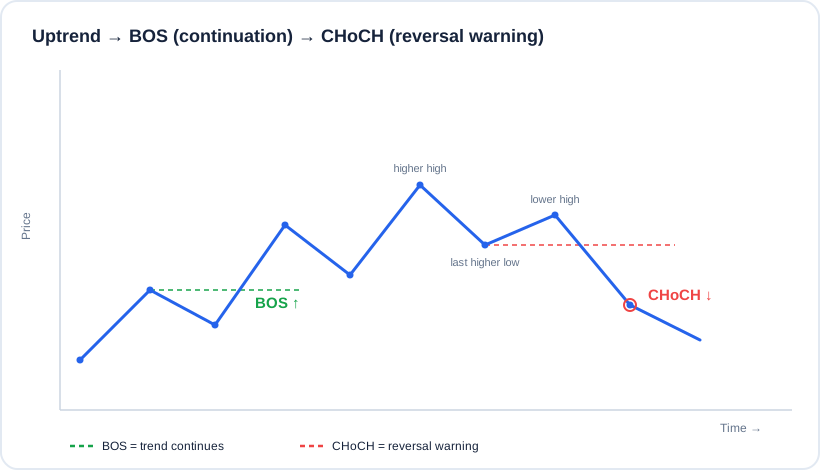
Structure is the foundation of everything else: a break of structure (BOS) confirms the trend continues, while a change of character (CHoCH) is the first clue that control is shifting hands.
Market Structure
Tell trend from reversal with BOS and CHoCH — before you risk a cent.
Liquidity
Why equal highs/lows are targets, not walls, and how smart money hunts them.
Order Blocks & FVG
Where institutions leave a footprint, and the 3 things that make one tradable.
Inducement
Why the obvious entry is usually bait — and how to wait for the real one.
Premium & Discount
The simple rule that stops you buying expensive and selling cheap.
Bonus: Free Webinar
See the whole framework applied live on real setups, candle by candle.
Your Path to Smart Money Trading
Learn via Email
A short series that deepens each concept with real examples.
AutomaticThe Four Terms That Trip Everyone Up
Most SMC confusion comes from mixing up these pairs. Learn them here — no signup — so the rest of the framework clicks into place.
| Term | What it is | What it tells you |
|---|---|---|
| Break of Structure (BOS) | Price breaks the most recent swing high (up) or low (down) in the direction of the trend. | The trend is continuing — momentum is still with the current side. |
| Change of Character (CHoCH) | Price breaks a swing point against the prevailing trend for the first time. | Control may be shifting — the first sign of a potential reversal. |
| Order Block (OB) | The last opposing candle before a strong, structure-breaking move — where institutions likely filled orders. | A zone price may return to and react from; a place to look for entries. |
| Fair Value Gap (FVG) | A 3-candle imbalance where price moved so fast it left an unfilled gap between wicks. | An inefficiency the market often revisits to 'rebalance' before continuing. |
Go Deeper — Free
Smart Money Concepts FAQ
Is SMC the same as ICT?
They overlap heavily but aren't identical. ICT (the Inner Circle Trader material) is one popular framework within the broader Smart Money Concepts family. VASA teaches the core SMC ideas — structure, liquidity, order blocks, inducement, premium/discount — as one clear, repeatable process rather than any single guru's exact naming.
Which timeframe should I use?
SMC is multi-timeframe by design: read the higher timeframe (e.g. daily or 4H) to find the direction and key zones, then drop to a lower timeframe (e.g. 15m or 5m) to time the entry. There's no single 'best' timeframe — the method is the same on all of them.
Do I need experience to learn SMC?
A little chart familiarity helps, but we start from market structure — the foundation everything else rests on. If you understand highs and lows, you can build up from there step by step.
Which markets does SMC work on?
Any liquid market with a chart — forex, indices, stocks, and crypto, anywhere in the world. The concepts describe how large participants interact with liquidity, which is universal.
Ready to Read Like Smart Money?
Download the free Smart Money Starter Kit and start spotting the setups that were sitting on your charts the whole time.
Get the Free Starter KitEducational content only — not financial advice. Trading involves substantial risk of loss and is not suitable for everyone.
Keep learning
Free reads and tools to go deeper on Smart Money Concepts.