Best Options Strategies for Small Accounts: A Beginner's Income Roadmap
You don't need a big account to sell options for income — you need defined-risk strategies. Here are the best options strategies for small accounts, ranked by capital and risk.
The most common thing people believe about options income is that it needs a big account. It doesn't — but it does need the right strategies. The trap for small accounts isn't lack of capital; it's using strategies whose risk is bigger than the account can survive. Get the order right and a few thousand dollars is enough to trade options sensibly.
This is an honest roadmap: which strategies actually suit a small account, why, and the one category to avoid until you've grown. Nothing here promises profit — options carry real risk of loss — but it will keep you from the mistakes that wipe small accounts out early.
The one rule that matters for small accounts
Before any strategy: on a small account, your risk on every trade must be defined — a known, capped number you set before you enter. That single rule rules out the strategies that blow accounts up and rules in the ones you can actually recover from.
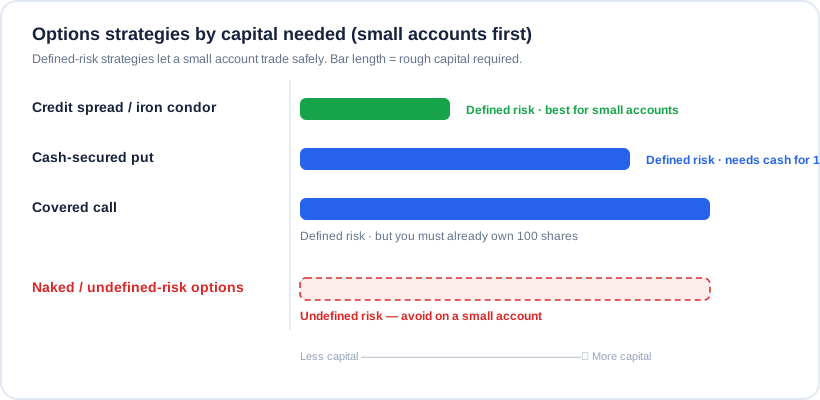
Ranked by capital and risk. Defined-risk strategies (green/blue) suit small accounts; undefined-risk strategies (red) do not.
The best strategies for a small account, in order
1. Credit spreads (start here)
A credit spread means you sell one option and buy a further-out one as protection. That bought option caps your maximum loss at a known number — usually the width of the spread minus the premium you collected. Because your risk is capped and small, the capital required is small too.
This is why credit spreads are the natural first income strategy for a small account: you can define exactly what you're risking, and it's a fraction of what an undefined position would tie up. You can model the numbers with our free credit spread calculator before you ever place one.
2. Cash-secured puts (once you can hold the shares)
A cash-secured put means selling a put while holding enough cash to buy 100 shares if you're assigned. Your risk is defined — the worst case is owning a stock you already wanted, at a discount — but it needs more capital, because you have to secure the full purchase.
For a small account, this works best on lower-priced quality stocks, where 100 shares is affordable. It's a step up from spreads in capital, and a genuinely useful income strategy once you can cover the assignment.
3. Covered calls (once you own 100 shares)
A covered call is selling a call against 100 shares you already own to collect premium. The risk is defined and it's a solid income strategy — but it needs the most capital of the three, because you have to own the round lot first. For most small accounts it comes later, often as the second half of the "Wheel" after a cash-secured put gets assigned.
The category to avoid: undefined-risk options
Get the Options Income Starter Kit
Five defined-risk ways to sell options for income — cash-secured puts, the Wheel, credit spreads, and more. Enter your email and we'll send the free kit to your inbox.
Selling naked options — a put or call with no protective long against it — can collect premium, but the potential loss is open-ended. One bad move can cost far more than the premium you took in, and on a small account that's the kind of loss you don't come back from. Until your account is larger and your experience deeper, keep every position defined-risk. This isn't caution for its own sake; it's the difference between a drawdown and a blow-up.
Strategies side by side
| Strategy | Capital needed | Risk | Best when |
|---|---|---|---|
| Credit spread | Lowest — spread width minus credit | Defined & small | You're starting out and want capped risk |
| Cash-secured put | Cash for 100 shares | Defined — may own the stock | You'd happily own the stock at the strike |
| Covered call | Own 100 shares | Defined | You already hold shares and want income |
| Naked options | Varies | Undefined | Not for small accounts — avoid |
How much do you actually need?
There's no magic number, but defined-risk spreads let you start meaningfully smaller than most people assume — often in the low four figures — while cash-secured puts and the Wheel realistically want more, depending on the price of the stocks you choose. We break the real figures down strategy by strategy in how much money you need to start selling options.
Whatever your number, the principle holds: never risk more than a small, fixed slice of the account on any single trade. Our free position-size and risk tools help you keep that honest.
Common small-account mistakes
- Chasing premium into undefined risk. Bigger premiums usually mean bigger or open-ended risk. On a small account, defined-risk-first, always.
- Trading too big. A defined-risk strategy still hurts if the position is a huge chunk of the account. Size so a full loss is survivable.
- Ignoring the underlying. Selling puts on a stock you wouldn't want to own is how "income" turns into a bad long-term hold. Only sell puts on quality you'd happily buy.
- Over-trading. More trades isn't more income; it's more commissions and more chances to be wrong. Fewer, better-structured trades win on a small account.
Key takeaways
- Small accounts can trade options — the constraint is risk type, not account size.
- Start with credit spreads (defined, low capital), then cash-secured puts, then covered calls as capital grows.
- Avoid undefined-risk (naked) options until you're bigger and more experienced.
- Define your risk before every trade and size so a full loss is survivable.
- Sell puts only on stocks you'd want to own at the strike.
The honest headline: a small account isn't a reason to avoid options income — it's a reason to be disciplined about which options you sell. Defined risk first, quality underlyings, sensible size. Do that and the account has room to grow instead of room to blow up.
VASA's free Options Income Starter Kit walks through these defined-risk strategies — cash-secured puts, the Wheel, and credit spreads — in plain English, with the real numbers. It's the honest starting point if you want income without the undefined-risk landmines.
Frequently asked questions
What is the safest options strategy for a small account? Defined-risk strategies are the safest because your maximum loss is capped and known before you enter. Credit spreads are usually the best starting point — low capital and a fixed maximum loss.
Can I sell options with a $1,000–$2,000 account? You can start with defined-risk credit spreads at that size, since the capital required is the spread width minus the credit. Cash-secured puts and covered calls generally need more, because you must secure or own 100 shares.
Are covered calls or cash-secured puts better for beginners? Cash-secured puts often come first because they don't require already owning shares — you sell the put, and if assigned you buy the stock at a discount. Covered calls follow once you hold 100 shares. Together they form the Wheel.
Why avoid naked options on a small account? Because their loss is undefined — potentially far larger than the premium collected. On a small account, a single undefined-risk loss can be unrecoverable. Keep every position defined-risk until you're larger and more experienced.
Get the Options Income Starter Kit
Five defined-risk ways to sell options for income — cash-secured puts, the Wheel, credit spreads, and more. Enter your email and we'll send the free kit to your inbox.
Prefer to watch first? Watch the free training
Educational content only — not financial advice. Trading involves substantial risk of loss and is not suitable for everyone.