Prop Firm Challenge Rules Explained: Why Most Traders Fail the Evaluation
Most traders fail a prop-firm challenge on a rule, not a bad strategy. Here's a plain-English breakdown of the evaluation rules — profit target, max daily loss, static vs trailing drawdown, the consistency rule — and why sizing, not prediction, decides who survives.
Most traders who fail a prop-firm challenge don't fail because their strategy is bad. They fail because they broke a rule — an oversized day that tripped the max daily loss, or a misread of how the drawdown actually works. The evaluation isn't really a test of whether you can predict the market. It's a test of whether you can trade inside someone else's rulebook without breaching it.
That's good news, because rules can be learned. Below is the honest version of what those rules are, why each one catches people out, and why the traders who pass tend to think about size long before they think about setups. This is education only — no evaluation is guaranteed, and most challenge buyers never reach a payout.
What a funded challenge actually is
A prop firm sells you an evaluation: hit a profit target without breaking a set of risk rules, and you're offered a funded account to trade the firm's capital, usually splitting the profits. Futures firms (Topstep, Apex) tend to use dollar-based limits and trailing drawdowns; forex and CFD firms (FTMO and similar) tend to use percentage limits and static ones. Those names are neutral examples of different rulebooks — not endorsements, and not affiliates.
The firm isn't betting you'll get rich. It's built around the reality that most people break a rule before they reach the target. Understanding the rulebook is how you stop being part of that majority by accident.
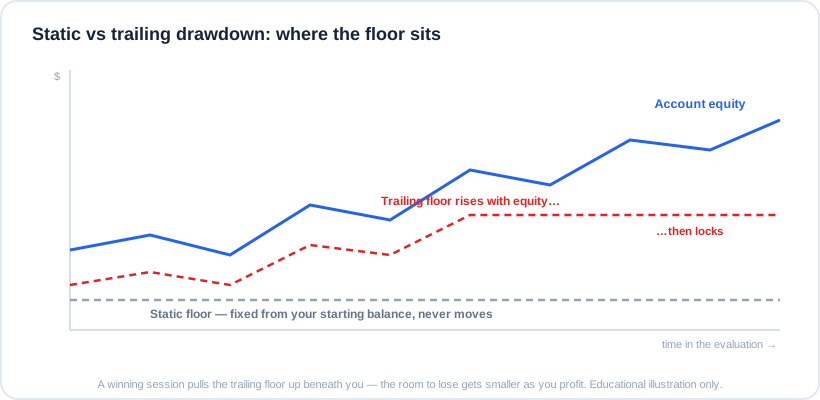
A static floor stays put; a trailing floor climbs with your equity — so a winning session quietly shrinks the room you have left to lose.
The rules that end most evaluations
There are usually six rules on the page. Three of them account for the large majority of failures.
1. Max daily loss
A hard floor on how much your account can drop in a single trading day — and it almost always counts open trades, not just closed ones. Touch it intraday, even for a moment, and the evaluation is over regardless of where price finishes.
The trap: people fail here by oversizing, not by being wrong. A couple of normal losers plus one revenge trade can breach the limit in a single afternoon. The rule didn't beat them; their position size did.
2. Max drawdown — static vs trailing
The overall floor on how far the account can fall from a reference point. This is the single most misunderstood rule, because the reference point behaves in two very different ways.
3. The consistency rule
Many firms require that no single day makes up more than roughly half of your total profit. A lucky home-run day can pass the profit target on paper and still gate the payout, because your results weren't consistent enough. Even, repeatable days matter more than one big one.
The other three — profit target, minimum trading days, and the fine print (news, weekend and lot-size limits, payout schedules) — matter too, but they trip far fewer people than the three above.
Static vs trailing drawdown, side by side
If you only learn one distinction before you pay a challenge fee, make it this one.
Get the Funded Trader Rulebook
The rules that fail most challenge-takers — max daily loss, static vs trailing drawdown, and the consistency rule — in plain English. Enter your email and we'll send the free Rulebook to your inbox.
| Static drawdown | Trailing drawdown | |
|---|---|---|
| Reference point | Fixed from your starting balance | Rises with your equity |
| How it moves | Doesn't move | Chases your highs, then often locks once you're a set amount in profit |
| What it feels like | Predictable floor from day one | The floor tightens beneath you as you win |
| Common in | Many forex / CFD firms | Many futures firms |
| The trap | Underestimating a bad day early | A green morning quietly raising your floor by the afternoon |
Neither is harder in the abstract — but trading a trailing-drawdown account as if it were static is one of the fastest ways to breach without realising why. Know which one you're on before you place a trade.
Why sizing beats prediction
Here's the shift that separates people who pass from people who keep re-buying challenges: you don't survive an evaluation by trading brilliantly. You survive it by not breaking a rule — and the biggest lever on that is position size, not signal quality.
A common, conservative approach is to risk against roughly half the firm's daily-loss limit, and to set a personal daily stop that's stricter than theirs. Size so that the worst realistic day still sits well inside the limit, and the max daily loss stops being a threat. It's structural, not emotional — you decide it before the session, not in the heat of a drawdown.
The hardest part isn't knowing this. It's actually stopping when you said you would. That's exactly where a tool like Trade Recovery AI earns its place: you set a max daily loss and it blocks further trading once you hit it — a circuit breaker for the discipline the rulebook demands. If you already know your weak spot is one bad afternoon, automating the stop removes the moment of temptation entirely. (Working out the size itself is just arithmetic — the free position size calculator does it from your account size, risk, and stop.)
An honest word on pass rates
You'll see plenty of marketing that implies passing is routine if you just buy the right course. It isn't. Industry-wide, only around 7% of challenge buyers ever reach a payout. That figure isn't mostly about talent — much of the gap is rules people didn't fully understand — but it's a real number, and anyone promising you'll pass or get funded is not being straight with you.
What preparation can honestly do is remove the avoidable failures: the breach you didn't see coming, the drawdown type you misread, the oversized day. It improves your odds of staying in the game. It does not guarantee an outcome, and no honest educator will tell you otherwise.
How to prepare before you pay a fee
- Read the specific firm's rulebook, in full. The rules above are the pattern; the numbers and the exact drawdown type vary by firm and account.
- Know which drawdown you're trading — static or trailing — and what locks it.
- Decide your size first. Risk against a fraction of the daily limit, and write a personal daily stop stricter than the firm's.
- Have a method already. A challenge is risk-and-rules preparation, not a strategy taught from scratch. If you don't yet have an approach you trust, build one first with a method course — price action, options, or smart money concepts — before you attempt an evaluation.
- Aim slow. Most evaluations have no time limit, so patience is free. Rushing only adds risk you don't need.
Key takeaways
- Most failures are rule breaches, not bad strategy — the evaluation tests whether you can trade inside a rulebook.
- Max daily loss ends the most evaluations, usually counting open trades — so size, not prediction, is the defence.
- Static vs trailing drawdown is the key distinction — a trailing floor tightens beneath you as you win.
- The consistency rule rewards even days over one home run.
- Passing is not guaranteed — around 7% of buyers reach a payout — but understanding the rules removes the avoidable failures.
The funded challenge is a rules problem before it's a skill problem. Learn the rulebook cold, size so a single day can't end your attempt, and you give yourself a fair chance — which is all any honest preparation can offer.
VASA's free Funded Trader Rulebook breaks down all six rules in plain English, with the trap in each, plus a pre-challenge checklist and a personal-rulebook template. It's the honest, education-only place to start — before you ever pay a challenge fee.
Frequently asked questions
Why do most traders fail prop firm challenges? Usually because they break a risk rule, not because their strategy is bad. The most common breach is the max daily loss, which typically counts open trades — one oversized or revenge-traded day can end the evaluation. Misreading the drawdown type is the next most common cause.
What is the difference between static and trailing drawdown? A static drawdown is a maximum loss level fixed from your starting balance that doesn't move. A trailing drawdown rises as your equity rises, so a winning session can tighten the floor beneath you — and some firms lock it once you're a set amount in profit. Trading a trailing account as if it were static is a frequent way to breach.
Can a course guarantee I'll pass and get funded? No — and anyone who promises that isn't being honest. Passing depends on you, your method, and the market, and most challenge buyers never reach a payout. Education can teach the rules and the risk math so you understand what you're walking into, but it can't promise an outcome.
Do I need a trading strategy before attempting a challenge? Yes. A challenge is risk-and-rules preparation, not a strategy taught from scratch. If you don't yet have a method you trust, build one first — then the rulebook prep sits on top of it.
Get the Funded Trader Rulebook
The rules that fail most challenge-takers — max daily loss, static vs trailing drawdown, and the consistency rule — in plain English. Enter your email and we'll send the free Rulebook to your inbox.
Prefer to watch first? Watch the free training
Educational content only — not financial advice. Trading involves substantial risk of loss and is not suitable for everyone.